
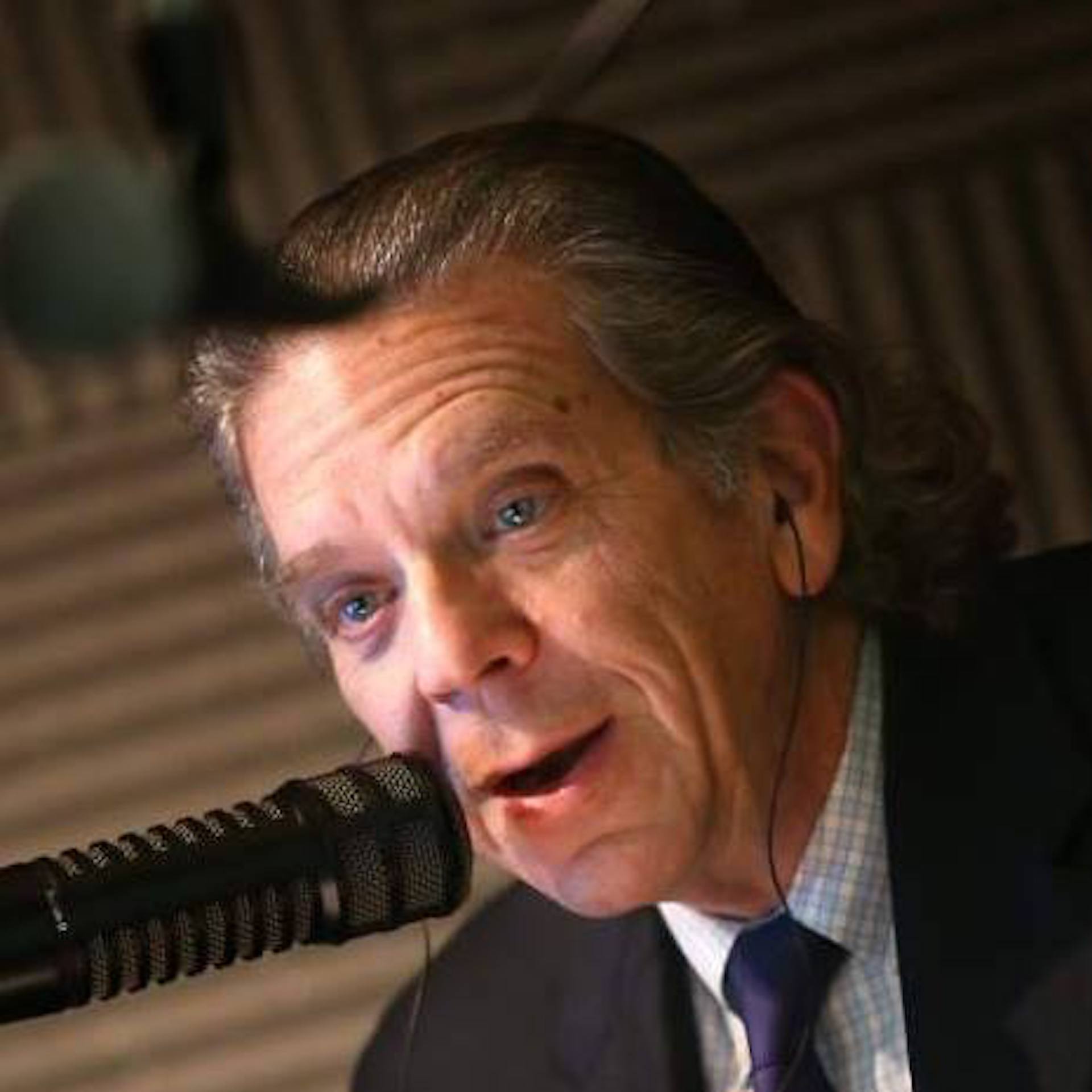
Jeff Schechtman talks with authors, journalists, and thought leaders.
Episodes
Wednesday May 13, 2009
Wednesday May 13, 2009
While usually followed by controversy, there can be little doubt about the soundness of Rashid Khalidi's arguments that today's Middle East conflicts were, in large measure, shaped by the Cold War. In his new book SOWING CRISIS, Khalidi shows how the global conflicts now playing out in the Middle East were significantly shaped and exacerbated by the Cold War era, and that any successful peace process must begin with a through understanding of these historical antecedents.

Tuesday May 12, 2009
Tuesday May 12, 2009
While we are just beginning to get a wave of books about the current financial crises, it's important to have a real historical understanding of how Wall Street, finance and big business got that way. The place to start that understanding is with with the life of Cornelius Vanderbilt. Starting as a Staten Island farmer, he rose to control one of the greatest fortunes in world history. He played a central role in the rise of the modern corporation, the emergence of Wall Street, and the birth of big business. His life played out on an enormous stage. His relationships went from George Washington to John D. Rockefeller. T.J. Stiles, who's just authored a new biography of Vanderbilt, entitled THE FIRST TYCOON, says that "no one kept his hands of the levers of the economy for so long and pushed so hard."
Monday May 11, 2009
Monday May 11, 2009
John Bradshaw has, over the years, helped many of us understand the complexity of life. Not by embracing popular maxims or formulas, but by helping us get in touch with the "better angels of our nature." Now in his newest work, RECLAIMING VIRTUE, he helps us to understand a kind of moral intelligence that he says, to few people develop. In this age of greed, Bernie Madoff's and ever growing selfishness, Bradshaw's lessons are perhaps more important. A talk with John Bradshaw is no ordinary conversation. It's a wild ride. Take a listen.
Monday May 11, 2009
Monday May 11, 2009
Last week we marked President Obama's first 100 days. Now that the dust and the hype have settled, we can really take a look at what we've learned about this young President. No one is better able to help us do that, then Jonathan Alter. His book about FDR's first hundred days, A DEFINING MOMENT:FDR'S HUNDRED DAYS AND THE TRIUMPH OF HOPE is a national best seller that even the President has read. He is a Senior Editor of Newsweek and a contributor to MSNBC.
Friday May 08, 2009
Friday May 08, 2009
What are the forces that cause us to continue eating when we know we should stop? Why has the quality of food, that most Americans eat, deteriorated even while more and more healthy choices are available? Why are our children experiencing an epidemic of obesity, and what role does the food industry play in this? These and many similar questions are the ones asked by Dr. David Kessler in his look at big food. Just as he took on the tobacco companies in the 80's, Dr. Kesser, in his new book THE END OF OVEREATING , takes on the food/industrial complex, that is clearly culpable in some of our bad food choices.
Thursday May 07, 2009
Thursday May 07, 2009
In his new book, DREAD: How Fear and Fantasy Have Fueled Epidemics from The Black Death to Avian Flu, Philip Alcabes says there is value in studying the history of epidemics as they reflect our inflated fears about what is unknown, undesirable, or misunderstood. For example, “gay plague” was the phrase which brutally insensitive headlines used to describe AIDS in the 1980s, and its comparison to The Black Death was a commentary on American sexual politics. Cholera was thought to be the disease of the poor and carried undertones of social change. Anthrax scares reflected our crippling fear of terrorist attacks, Avian flu played on our fear of China and now Swine flu, exploits our concerns about immigration. Philip Alcabes unravels the history of the epidemic as a phenomenon in human society, where what fear says more about us than the disease.
Wednesday May 06, 2009
Wednesday May 06, 2009
Beyond the headlines, the hot spots and the bombings are millions of people who go about their daily lives each day in the Middle East. People who eat, drink, play, love and engage in the stuff of everyday life. To those of us in the West, they often seem invisible. Some are eccentric, some normal. But very few represent what we see in the daily stories of life in the Middle East. It has been left to Neil MacFarquhar, to document their lives. He does so brilliantly in his new book THE MEDIA RELATIONS DEPARTMENT OF HIZBOLLAH WISHES YOU A HAPPY BIRTHDAY.
Tuesday May 05, 2009
Tuesday May 05, 2009
A couple of weeks ago 60 Minutes did a segment on what was happening to the Elephant population of Africa. John Frederick Walker has been warning us about this. Long before gold and gemstones held allure, humans were drawn to the “jewels of the elephant”—its great tusks—for their beauty, rarity, and ability to be finely carved. In Ivory’s Ghosts, John Frederick Walker tells the astonishing story of the human lust for ivory and its cataclysmic implications for elephants. Each age and each culture, from ancient Egypt to nineteenth-century America and modern Japan, found its own artistic, religious, and even industrial uses for the remarkable material that comes from the teeth of elephants and a handful of other mammals. Sensuous figurines, scientific instruments, pistol grips, and piano keys were all the result—as was human enslavement and the wholesale slaughter of elephants.
Monday May 04, 2009
Monday May 04, 2009
Opponents of same-sex marriage in the United States claim that it would undermine the institution of marriage, weaken family structures, and cause harm to children. Drawing on 17 years of data and experience with same-sex marriage in Scandinavia (in the form of registered partnerships), Gay Marriage: For Better or for Worse? is the first book to present empirical evidence about the effects of same-sex marriage on society. William Eskridge, one of our nations most distinguished law professors and scholars on the subject, finds that the evidence refutes conservative defense-of-marriage arguments and, in fact, demonstrates that the institution of marriage may indeed benefit from the legalization of gay marriage.
Saturday May 02, 2009
Saturday May 02, 2009
“Cash or credit? Plastic or Paper? Punt or go for first down? Deal or no deal? Life is filled with puzzling choices. The complexity of modern life adds an almost dizzying array of choices. Reporting from the frontiers of neuroscience and armed with riveting case studies of how pilots, quarterbacks, and others act under fire, Jonah Lehrer presents a dazzlingly authoritative and accessible account of how we make decisions, what’s happening in our heads as we do so, and how we might all become better ‘deciders.’ Lehrer is the author of the popular science blog Frontal Cortex. He writes for Wired and Seed maganiznes. His latest book is HOW WE DECIDE.
Friday May 01, 2009
Friday May 01, 2009
It's impossible to emphasize enough how different our current President is from the last one. Regardless of policy, simply the ability to see the nation and the world through the lens of big ideas, and understand that we are "not in Kansas anymore." That modernity, technology and the economic and social crises we face have put us at some kind of inflection point in the nation's history. Obama touches on all of this, in a wide ranging fifty-minute interview with New York Times economics correspondent David Leonhardt. That interview appears as the cover story in this Sunday's New York Times Magazine. My conversation with David Leonhardt about his impressions from that Obama interview:
Thursday Apr 30, 2009
Thursday Apr 30, 2009
With the Republican brand all but destroyed, with fewer than twenty-five percent of Americans self identifying as Republicans, as conservatism become synonyms with fundamentalism, ignorance of science and the acceptance of torture, it seems that some would try hard to redefine and re brand the once proud tradition of conservatism. Kim Phillips-Fein, a historian at New York University tries to do it by arguing that its historic, post New Deal strength was as the party of big business. I'm not sure it's a goal conservatives should aspire to today, but it's an interesting theory.
Wednesday Apr 29, 2009
Wednesday Apr 29, 2009
As we mark the first 100 days of the Obama administration, many will obviously view it in different ways. But perhaps first among the many ways involves responsibility and accountability. Stephanie Robinson, a lecturer on Law at Harvard Law School, and former chief Counsel Senator Ted Kennedy and the author of ACCOUNTABLE, argues that accountability is the essential maker for good public policy.
Saturday Apr 25, 2009
Saturday Apr 25, 2009
Two interesting pieces trying to figure out Obama's economic policy though the idea of "Nudge." The first article by Franklin Foer, in The New Republic entitled Nudge-ocracy and the second by Derek Thompson in The Atlantic. Both miss the point that all of these ideas were spelled out over a year ago by Obama's University of Chicago colleagues, Cass Sustein and Richard Thaler in their book Nudge: Improving Decisions About Health, Wealth, and Happiness.
Friday Apr 24, 2009
Friday Apr 24, 2009
Andrew Cherlin argues that marriage in America is totally unique, as compared to the rest of the world. We value marriage and commitment, yet the American strain of independence and freedom is equally powerful. This dichotomy has helped to define marriage in America and may even help explain some of the debate our same sex marriage. In his new book, The Marriage-Go-Round: The State of Marriage and the Family in America Today, Cherlin deconstructs marriage in a way that even Woody Allen would have found helpful.
Tuesday Apr 21, 2009
Tuesday Apr 21, 2009
Award-winning journalist Alec Russell was in South Africa to witness the fall of apartheid and the remarkable reconciliation of Nelson Mandela’s rule; and returned in 2007-2008 to see Mandela’s successor, Thabo Mbeki, risk the country’s reputation. South Africa is now perched on a precipice, as it prepares to elect Jacob Zuma as president on April 21st—signaling a potential slide back to the bad old days of post-colonial African leadership, and disaster for a country that was once the beacon of hope for the continent. Drawing on his long relationships with all the key senior figures including Mandela, Mbeki, Desmond Tutu, and Zuma, and a host of South Africans he has known over the years, Alec Russell’s Bring Me My Machine Gun: The Battle for the Soul of South Africa, from Mandela to Zuma is an expertly observed and reportered account of South Africa’s great tragedies and unfulfilled promise.
Tuesday Apr 21, 2009
Tuesday Apr 21, 2009
My conversation with former anti-war activist and 60's radical William Ayers. We discussed his book Fugitive Days: Memoirs of an Anti-War Activist just reissued, plus the panoply of his past and present views.
Tuesday Apr 21, 2009
Tuesday Apr 21, 2009
The recent presidential campaign and the controversy surrounding Bill Ayers reignited the debate about anti war protesters in the 60's. What value did they have and how did the violent ways of some of them help or hurt the movement? Mark Rudd has spent the last forty years evaluating the choices he made as a member of Students for a Democratic Society (SDS) and the more violent Weather Underground. In his new memoir, Underground: My Life with SDS and the Weathermen, Mark Rudd reveals the first hand drama as well as the naivete of one of the most controversial periods in U.S. history.
Thursday Apr 16, 2009
Thursday Apr 16, 2009
If there is a single touchstone to the culture wars around the world, it is the issue of reproductive choice. More than just a domestic rallying point for the far right, reproductive choice has become an issue of global importance. Michelle Goldberg, has spent years researching this issue. In her new book, THE MEANS OF REPRODUCTION: Sex, Power, and the Future of the World, she argues that in nations where reproductive choice has been an issue of population control, there has been less controversy. Where the rights of woman have been directly tied to reproductive choice controversy and militant fundamentalism abound.
Monday Apr 13, 2009
Monday Apr 13, 2009
Exactly ten years ago next week, on April 20, 1999, the nation suffered one of the great tragedies of the 20th Century. That day Eric Harris and Dylan Klebold walked into Columbine High School and opened fire on their classmates. When it was over they killed 11 students and 1 teacher, before killing themselves. Our understanding is only now clear because of the work of Dave Cullen, a journalist who has covered the story from hours after it happened and has devoted the past ten years to trying to fully understand it. His new book COLUMBINE is the definitive account of the incident.
Monday Apr 13, 2009
Monday Apr 13, 2009
Alva Noe, a professor of philosophy at UC Berkley challenges the assumptions underlying neuroscientific studies of consciousness, rejecting popular mechanistic theories that our experience of the world stems only from the firing of the neurons in our brains.
Thursday Apr 09, 2009
Thursday Apr 09, 2009
Thursday Apr 09, 2009
About a year ago I had a conversation with journalist Pico Iyer about his friend the Dali Lama. Iyer has a long history with the Dalai Lama, the Tibetan spiritual leader living in exile in India. Earlier this week Iyer joined me once again to discuss how the fourteenth Dalai Lama is responding to the current reality of the Tibetan crises virtually disappearing from public discussion. This was my first conversation with Iyer in April of last year.
Tuesday Apr 07, 2009
Tuesday Apr 07, 2009
We all know that the Obama administration wants a greener energy future and that the world demands it. It would seem that everybody but George Will is on board.... and of course the oil companies. Hard to believe, but big oil is still resisting the obvious. The New York Times details on page one today. Earlier today, I spoke to Miriam Horn, journalist and a member of the Environmental Defense Fund about some of the unique efforts in alternative energy and about what the oil companies are up to:
Thursday Apr 02, 2009
Thursday Apr 02, 2009
Today the very ideas that made America great imperil its future. Our plans go awry and policies fail. History's grandest war against terrorism creates more terrorists. Global capitalism, intended to improve lives, increases the gap between rich and poor. Decisions made to stem a financial crisis guarantee its worsening. Environmental strategies to protect species lead to their extinction. The traditional physics of power has been replaced by something radically different. In The Age of the Unthinkable, Joshua Cooper Ramo puts forth a revelatory new model for understanding our dangerously unpredictable world. Drawing upon history, economics, complexity theory, psychology, immunology, and the science of networks, he describes a new landscape of inherent unpredictability--and remarkable, wonderful possibility.
Wednesday Apr 01, 2009
Wednesday Apr 01, 2009
The crises in Darfur has become one of the most notable causes of our time. We talk of genocide, the death of 400,000 people and impact of the war on terror. The reality of Darfur and the Sudan may in fact be entirely different. What if everything we know about Darfur is either wrong or misjudged. This is the topic of a new book by Mahmood Mamdani of Columbia University, entitled SAVIORS and SURVIVORS Darfur, Politics, and the War on Terror.
Wednesday Apr 01, 2009
Wednesday Apr 01, 2009
How will history ultimately judge the colossal failures in Iraq? Those failures, compound by arrogance and politics have cost us a trillion dollars and thousands of American lives. Arguably none of it was necessary to achieve our stated objectives. Charles Duelfer, who served as the deputy chairman of the United Nations weapons inspection organization from 1993 to 2000 and was also the leader of the Iraq Survey Group, which was the CIA-led team charged with the search for weapons of mass destruction in Iraq details the folly in his new book HIDE AND SEEK
Tuesday Mar 31, 2009
Tuesday Mar 31, 2009
Dambisa Moyo makes a compelling case for a new approach in Africa. Her message is that Africa's time is now. It is time for Africans to assume full control over their economic and political destiny.
Monday Mar 30, 2009
Monday Mar 30, 2009
The man who came up with phrase "The World is Flat" for his friend Tom Friedman expounds on the nations's developmental issues and possible policy solutions to continue the "Indian miracle."
Sunday Mar 29, 2009
Sunday Mar 29, 2009
How will different parts of the county survive in the current economic crises? Will cities and suburbs have to reinvent themselves and how has the physical character and geography of the country shaped consumption, production and innovation? Richard Florida, one of our nations leading urban theorists, and the author of Who's Your City?: How the Creative Economy Is Making Where to Live the Most Important Decision of Your Life,argues that to a surprising degree, the cause of the current crash is geographic in nature and that comming out of the recession will will require a "new kind of geography," what he calls a "spatial fix." He lays all of this out in the cover story in the March issue of the The Atlantic entitled THE GREAT RESET: How the Crash will Reshape America.
Wednesday Mar 25, 2009
Wednesday Mar 25, 2009
Richard Yates is getting a new following since the movie Revolutionary Road. Cheever is the subject of a new biography and Updike has had a revival since his death. Yet, the women who wrote some great work during this same period seemingly have been overlooked. Elaine Showalter believes it is high time to fully integrate the contributions of women into our American literary heritage, and she undertakes the task with brilliance and flair, making the case for the unfairly overlooked and putting the overrated firmly in their place. She has written A JURY OF HER PEERS. A book that will greatly enrich our understanding of American literary history and culture. My conversation with Elaine Showalter:
Wednesday Mar 25, 2009
Wednesday Mar 25, 2009
The United States imports the majority of its oil, not from the Middle East, but from Canada? Canada has one third of the world's oil resources; it comes from the bitumen in the oil sands of Alberta. It burns more carbon than conventional oil. It destroys forests and displaces wildlife. It poisons the water supply of communities downstream and drains the Athabasca, the river that feeds Canada's largest watershed. It's one of the largest energy projects in the world.
Friday Mar 20, 2009
Friday Mar 20, 2009
Buzz. What is it, how does it get started and can it be manipulated. Whether it's the Obama campaign or the latest hot book or movie, marketing today is dictated by a whole new set a rules that stand the old ideas about advertising, public relations and traditional marking upside down. One of the top practitioners of this new "art" is David Scott. He written a new book entitled World Wide Rave. My conversation with David Scott:
Thursday Mar 19, 2009
Thursday Mar 19, 2009
Winner of this years National Book Critics Circle award for Non-Fiction, Dexter Finkins is clearly the finest war correspondent of our time. My conversation with him, when his book came out back in October of last year.
Thursday Mar 19, 2009
Wednesday Mar 18, 2009